Commercial vehicle electrical installations
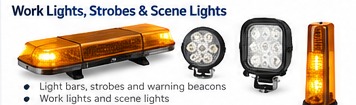
JRGMTS installs practical electrical equipment and auxiliary power systems in vans and suitable commercial vehicles. We commonly fit LAP warning lights, strobes, light bars and scene/work lighting, while remaining happy to install other suitable equipment requested by the customer.
Work can range from a pair of work lights to a complete fused power and control system.
Strobes, warning lights and scene lights
We install suitable strobe/warning lights, work lights and scene lights with appropriate switching, relays and protection. Scene lights illuminate a wide working area around a vehicle; work lights are generally aimed at a specific task area.
Why relays and fuses matter
A high-power lamp should not necessarily have its full current running through a small dashboard switch. A relay lets the switch control the load while the heavier current takes a protected route. The fuse protects the cable if a fault occurs.
Auxiliary power systems
- Second-battery systems
- VSR or DC-to-DC charging
- 12V outlets and USB charging
- Inverters and remote AC sockets
- Fuse boards, busbars, relays and control panels
- Load-area and tool-area lighting
- Dash cams, trackers and reversing cameras
Power planning in plain English
Ten 20W work lamps represent a 200W load. At 12V that is roughly 17A before losses, so cable, fuse and switching need to be designed for that current and cable length.
Built for serviceability
Commercial vehicles are working tools, so we favour labelled, fused and accessible installations.
Frequently asked questions
Can you fit customer-supplied strobes and lights?
We can assess them for suitability and completeness.
Can you build an auxiliary battery system?
Yes, sized around the expected loads and charging system.
Can cameras, trackers and lighting be combined?
Yes. Planning them together can produce a cleaner system.